“When are the Chinese coming?!” my 4-year old son Yeshaya asked me enthusiastically last Friday morning. You see, that night we were to be hosting 20 tour agents from China for a Shabbat meal. My children were overwhelmingly, well, gung ho about the idea.  I responded to Yeshaya, “Our guests from China won’t be coming for another 7 hours.” He thought for a moment and proclaimed with great know-how to his younger sister, “Because it takes 7 hours to get here from China.”

Seeing that I had a stumbled upon a great educational opportunity, I proceeded to explain to him that they weren’t coming all the way from China just for dinner, but rather that they were coming to visit the Land of Israel because it’s an important and precious place in the world. “They go from spot to spot learning about the country, and one of their spots is our Shabbat table.” Hence began a lengthy discussion of what’s so special about Israel, about Shabbat..and even about our house. I watched as a quiet flush of pride washed over Yeshaya’s face. 

One of the things I love about being a host family for tourists is precisely this sense of pride that I see flourishing in my children as they share the beauty of Shabbat & Jerusalem with people from across the globe. What could be better than coming together over a scrumptious meal, sharing with and learning from a vast array of guests from every walk and creed, and exposing my children to the wider world from the secure comfort of our own living room? Each week we accumulate new friends from new lands, with new stories and a slew of new Shabbat memories. 

And then there is that other wonderful gift that comes with hosting our international guests. It’s what I call ‘tourist goggles’.  For as part of the evening program  we take the group on a personalized tour of the Old City as the siren sounds for candle-lighting. Of course, the highlight of the tour is the moment we step out onto the plaza of the Western Wall. Our ears meet the symphony of 3000 people all gathered together for Shabbat at this majestic holy site. Our eyes meet the many faces of the Jewish people…strimmel-stacked Hassidim, black-hatted haredim, uniformed soldiers, starry-eyed “birthrighters”. Everyone a little awe-struck, all dressed a little differently, yet all shuffling around together on the same white-stone stage.  And that’s when I put on my very own pair of “tourist goggles”. For when they glimpse the Western Wall for the first time, I am able to glimpse the Wall for the first time. I borrow from them their eyes and encounter this sacred site again for myself.

Time and again I find that in sharing ourselves, our city and our rituals with others we are able to re-encounter our own life in poignant new ways. All too often, in  the daily drone of my days, I forget just how miraculous this city is. Usually it is little more than the scruffy streets where I shlep my bags and pay my bills, where I get stuck in traffic and kvetch in unison with the passengers in the car. 

But after an evening of hosting, I am able to remind myself that I have been waiting 2000 years to get stuck in precisely this Jerusalem traffic. I have been waiting 2000 years to pay these bills and shlep up these scruffy streets. I have been waiting 2000 years to share the gift of Shabbat in Jerusalem with the pilgrims of the world. 


One of the many remarkable things about the great revelation at Sinai was that, “All the people saw the thunder/voices”, rather than heard the thunder/voices of revelation. (Esodus, 20:15) 

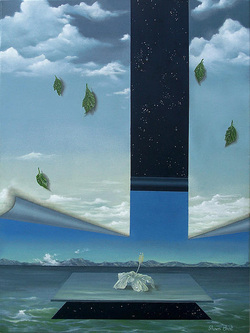
Essentially, revelation was an overwhelming experience of synesthesia; where all of one’s senses become unified and interchangeable. Seeing with ears and hearing with eyes; this is the heightened state of awareness whereby one can apprehend the voice of the divine. May we merit!

Synesthesia

Lord let us

-Like at Sinai -

speak more

brightly

sip your

incense


step more

soundly

drip your

entrance

see more

loudly

taste your

statements


feel your

vision

think your

fragrance

let us learn

with senses

sacred

what You

murmur in each

language

teach us

taste us

grant us

grace us

greet us

gratis

soothe us

sate us

melt a mountain

move and mage us

with scent

and sentence

Inundate us


This week in the Omer Count is the week of Nezach. (Each of the 7 weeks of the Omer count features a different Sefira (a particular energy or characteristic of reality.) Nezach means 'victory, triumph', when a struggle has been overcome. And yet, the dark side of Nezach is that, in our world, one person's victory is all too often another's defeat. I once heard Rebbetzin Yemima Mizrachi say, 'The biggest thing you win when you win an argument is an enemy.'

 It is interesting that Israeli Independence Day always falls around the week of Nezach. And, unfortunately, Israeli Independence Day is inevitably paired with Nakba Day, the Palestinian Day of "Catastrophe". They come as a unit, going hand in unhappy hand.

 The conflict reminds me of an idea from Gestalt Psychology on the theme of power dynamics in relationships. It's called "Top-Dog, Bottom-Dog". The Top-Dog position or personality is essentially the Alpha Male prototype, aggressive, definite, strong, articulate, leading. Top-Dog represents overt, expressed, power. The bottom-dog position on the other hand is all about covert power and unexpressed emotions. The bottom-dog is weak, subservient, acquiescing, complaining, insecure, victimized...the martyr. But this weakness is deceptive because the weakness is actually being used as a strength.

 The bottom-dog wields just as much power as the top. For it is the epitome of passive-aggressive behavior (PA). It utilizes subtle tactics such as undermining, learned helplessness, resentment, blaming, in order to control the relationship. The classic example of PA behavior is the husband who hates grocery shopping yet reluctantly agrees to go, sulking all the while. He returns with all the wrong items, mired in insecurity about being such an "unsuccessful shopper". Sure enough, the wife is the bad guy who put him into such a painful situation and set him up to fail...and, most importantly, he is never asked to shop again. The passive-aggressor gets the double benefit of being the 'good guy' and still getting his way, as opposed to the top-dog who may get his way, but gets forever labeled as the bad guy because of it.

  If we were to simplistically apply this framework to the national occurrences around this week of Nezach, then Israeli Independence Day would stand out as the top-dog and Nakba Day as the bottom-dog. Israeli Independence Day is a day of expressed power, flags foisted, jets streaking the sky; a day celebrating victory, national strength, independence, assertion, pride. Nakba Day on the other hand represents the sulking bottom-dog, the wounded victim of the evil aggressors. 'Protesters' break through Israel's borders, get shot at in response, and piteously lick their wounds before the concerned eyes of international media. 

Though they use their fair share of aggressive techniques, their most powerful and effective weapon is passive-aggression....the triumphant loser who actually wins the PR war of pity. (A wing of the PA winning a war of PR using PA tactics?!) While this is certainly an over-simplified view of the Arab-Israeli conflict, I think it offers a prism for understanding part of the power-dynamics at play in the world around us.

And surely these dynamics are equally at play in the world within us. One of the gifts of counting the Omer is that it offers us the opportunity to look into our inner worlds by delving into the themes presented each week by each new Sefira. The political occurrences of this week add fuel to the fire of our inner-growth.

During the week of Nezach, we can ask ourselves how to experience 'victory' that is actually a win-win situation. After all, another meaning of Nezach is endurance/forever-ness. True victory should mean a ceasing of the conflict, not its drawn-out continuation. Though we may not be able to impact the external political reality around us, we are able and compelled to impact our internal reality. Here at the end of the week of Nezach we are invited to look into our own interpersonal power dynamics and tendencies. Where am I falling into the extreme positions of top-dog or bottom dog? How can I create the lasting good and success for all that comes with win-win victories?

Transformative Torah Tools: Here are 3 essential tools for extracting ourselves from such unhealthy power dynamics:

  1. Consciousness

  2. Centering

  3. Communication

Consciousness: First, look carefully at a relationship where you are having challenges. Is there an underlying power struggle happening? What role might you be taking to gain power and control in the situation? Take responsibility for your part in the dynamic.

 Centering: Anchor in to your place of truth. What is the essential truth and deeply valid reason that you are taking your position? When you anchor in to your truth, you are much less likely to get defensive in the face of someone else's attack, to give in to another person's perspective, or to attack another.

 Communication: Talk about your feelings clearly and directly. Communication is the key to unraveling those pesky passive-aggressive dynamics which are built upon lack of clear expression. Expressing hitherto unarticulated emotions dissolves much of the negative tension of power struggles. Stick with "I feel" statements, such as "I feel frustrated when I can't express myself clearly." Express the positive as well as the negative feelings. Mine your emotions for the positive layers of feeling beneath. Instead of simply saying, "I feel frustrated when we argue", add "I feel sad when we argue because I love and value you."

 Of course, these steps will not vanquish all of our power-struggles and conflict so that we live a conflict-free existence. Rather, they can help us to work with and work through each conflict as it arises....and in the end, that ability to cope with and grow from each conflict is the greatest victory of all. A victory that is a win-win for everyone. A victory that will endure.


“When are the Chinese coming?!” my 4-year old son Yeshaya asked me enthusiastically last Friday morning. You see, that night we were to be hosting 20 tour agents from China for a Shabbat meal with the organization “Shabbat of a Lifetime”. My children were overwhelmingly, well, gung ho about the idea.  I responded to Yeshaya, “Our guests from China won’t be coming for another 7 hours.” He thought for a moment and proclaimed with great know-how to his younger sister, “Because it takes 7 hours to get here from China.”

Seeing that I had a stumbled upon a great educational opportunity, I proceeded to explain to him that they weren’t coming all the way from China just for dinner, but rather that they were coming to visit the Land of Israel because it’s an important and precious place in the world. “They go from spot to spot learning about the country, and one of their spots is our Shabbat table.” Hence began a lengthy discussion of what’s so special about Israel, about Shabbat..and even about our house. I watched as a quiet flush of pride washed over Yeshaya’s face. 

One of the things I love about being a host family for Shabbat of a Lifetime is precisely this sense of pride that I see flourishing in my children as they share the beauty of Shabbat & Jerusalem with people from across the globe. What could be better than coming together over a scrumptious meal, sharing with and learning from a vast array of guests from every walk and creed, and exposing my children to the wider world from the secure comfort of our own living room? Each week we accumulate new friends from new lands, with new stories and a slew of new Shabbat memories. 

And then there is that other wonderful gift that comes with hosting our international guests. It’s what I call ‘tourist goggles’.  For as part of the evening program we take the group on a personalized tour of the Old City as the siren sounds for candle-lighting. Of course, the highlight of the tour is the moment we step out onto the plaza of the Western Wall. Our ears meet the symphony of 3000 people all gathered together for Shabbat at this majestic holy site. Our eyes meet the many faces of the Jewish people…strimmel-stacked Hassidim, black-hatted haredim, uniformed soldiers, starry-eyed “birthrighters”. Everyone a little awe-struck, all dressed a little differently, yet all shuffling around together on the same white-stone stage.  And that’s when I put on my very own pair of “tourist goggles”. For when they glimpse the Western Wall for the first time, I am able to glimpse the Wall for the first time. I borrow from them their eyes and encounter this sacred site again for myself.

Time and again I find that in sharing ourselves, our city and our rituals with others we are able to re-encounter our own life in poignant new ways. All too often, in  the daily drone of my days, I forget just how miraculous this city is. Usually it is little more than the scruffy streets where I shlep my bags and pay my bills, where I get stuck in traffic and kvetch in unison with the passengers in the car. But after an evening of Shabbat of a Lifetime, I am able to remind myself that I have been waiting 2000 years to get stuck in precisely this Jerusalem traffic. I have been waiting 2000 years to pay these bills and shlep up these scruffy streets. I have been waiting 2000 years to share the gift of Shabbat in Jerusalem with the pilgrims of the world. 


This week we read of how the plague of tzaarat, biblical leprosy, is not limited to skin, but also appears on houses and clothing. The text reads, “When you come into the land of Canaan which I give to you as a possession, and I give you the plague of leprosy of the house...." (Leviticus 14:34) One thing that is striking here is the language of gifting that is used. First there is the reference to the gifting of the land, and then the gifting of the plague on the houses. But what kind of a gift is a plague?1 The subtle wording of the passage begs the question, 'How can a plague be a gift?'

One way we can start to answer that question is to look at what plagues us in our own everday lives. Today we call our common plagjues 'symptoms'. As a therapist, I often have clients who come to me bemoaning this or that symptom, from over-eating to tooth-grinding to reckless behavior. The symptom is always the bad guy, the noxious interloper they want to get rid of – and fast. Of course, we all want to be plague-and-symptom-free. But sometimes in our rush to get rid of our symptoms we lose the invaluable gifts they came to offer.

Take Sara, a woman suffering from insomnia. She had tried everything, sleeping pills, smoking marijuana, reading boring textbooks in bed. She was still painfully rest-less and wanted help. I asked her to spend a week pondering the question, “What is the gift of this symptom?”

She returned the next session with a remarkable story. She said that she realized that the insomnia's gift was that it protected her from dreaming. For when she dreamed she would often have terrifying nightmares of a childhood trauma. The insomnia both protected her, as well as alerted her. It stood as a signal to the fact that she was covering up something much deeper. Almost immediately upon realizing this, her sleeplessness ceased. It was as if the crucial information her insomnia had come to communicate had finally been received and no longer needed to blare its message.

Sara began to grapple with her trauma. And though it was an arduous process, it was deeply rewarding work that vastly improved the entirety of her life. Her insomnia was the gift that opened up the doorway to her deepest healing.

Now, let's return to our teaching on the leprosy of the walls with this in mind.2 The Torah's central commentator, Rashi, has an enigmatic response to our verse about the 'gift' of the leprosy. He notes that the gift is a reference to the fact that there was gold hidden in the houses by its previous owners. When they tore down the plagued walls they discovered the treasure.

This Rashi can be read from a psycho-spiritual perspective to say that when there is a discoloration on the surface of our lives, when there is a symptom, it is an indication of something precious and vital hidden underneath. The symptomatic plauge prompts us to to look deeper. And in the process we find gold. For, in the end, our greatest treasure is the joy that is born from growth and transformation.

Next time you are beset by a symptom, instead of poping a pill or chasing after a quick fix, take the time to stop and reframe the pain. Ask yourself, “What is the gift of this symptom?” For, in essence, a symptom is nothing short of a correspondence from your soul and a gift from God. It is an invaluable communication from our deepest self and divinest heights...a whisper worth listening to.

 *
 The Gift

The house went jade
 And heaved like yeast
 It pulsed and swelled
 cursed and grieved

 A pestilence on plaster
 A plague on skin
 And how we all wept
 when the walls finally fell in

but wept not with sorrow
 not shame, not remorse
 yes, all those things,
 but wept with much more

 wept with the knowledge
 that we’d been addressed
 written a warning
 connected to, expressed

As if we could touch
 The script-scribling hand
 That wrote on the surface
 That rank reprimand

The hand has decreed
Never mind the disease -
 Has given a sign,
 Has spoken
 inarguably

 Write on our walls
 whatever You will
 tell us were wrong
 judge us our guilt

What do we care
 if the content be kind
 Your Will has been spoken
 a token of treasure
 buried inside

 Whether succor staff or striking rod
 Curse is comfort
 When cursed by God

So with grace let us welcome
 Your Hand in our midst
 and usher in an era when
Affliction is a Gift


1Why not use a harsher terms like 'smite' or 'strike', verbs that were used for the plagues in Egypt?

2These two sources were cited in a wonderful article written by Rabbi Shlomo Riskin on a related theme.   


This week's reading delves into finely detailed descriptions of the Tabernacle's sacrifices. How do we understand and integrate these images of the ritualized blood and fire into our lives today? Where does this text meet our most intimate and personal lives?

One stunning example of a personalization of the priestly offerings is found in the 19th century commentary from the Sefat Emet on this week's parsha. It takes as its starting point the theme of tending to the fire on the Tabernacle's altar. The Torah reads, “A fire must always burn, it must not go out.” (Lev. 6:6). The Sefat Emet personalizes this continual fire as representative of the eternal flame of love for God that burns within each of our souls.

In an elegant Hassidic twist, he sees the injunction of “you must not let it (the fire) go out,” as not just a prohibition, but rather as a promise – a promise that this flame of love within each of us will not, can not, be extinguished. Our love of God is an essential birth-right, as constant as gravity, a flame that can never be quenched.

The Sefat Emet adds that each stray, distracting or negative thought that arises in our minds is an olah, a burnt-offering, that is meant to be consumed in this flame of love. As the Zohar says, “an evil thought is a burnt-offering upon its altar.”

In the Sefat Emet's vision, we are each the consecreated priests whose sacred duty it is to have stray, debased and distracting thoughts! We are programmed to have negative thoughts so that we may take and bind them on an altar of God-consciousness and love. Our work as servants of the Most High is not that we should have only pure, God-focused thoughts, but that we are destined to have negative spirals of thinking. Our task is to actively engage those stray thoughts and bind them upon an inner-altar. The thoughts are consumed in the conflagrations of our connection to God. These lowest of thoughts become the most precious of offerings, morphed and redeemed in the flames of consciousness. This is our highest vocation and divine service.

In a beautiful moment of serendipity, one of my clients this week sat before me in anguish, lamenting over a negative and recurring thought that has been plaguing her. She is daily beset by an image of a photograph she had seen of her ex-boyfriend and his new girl-friend. She described how this vivid image literally rises up in her mind, overwhelming her with its persistance. Her description was a mirror-image of the teaching from the Sefat Emet where he links the 'olah', the 'rising' offering, to the rising up of negative thoughts. How fortuitious that we had on hand this teaching. The Sefat Emet offers us a model for a practical Torah-based tool for transforming negative thoughts into opportunities for sanctification.

Integration exercise: 
Notice the next time you have a stray negative thought – whether it be an unfounded fear, an unproductive worry, an inappropriate desire, a caustic judgment. When this thought arises, don't just brush it aside, but rather take a hold of it, the way you might take a hold of calf, a ram, a pigeon. Imagine that you are binding it and lifting it up as a most esteemed offering. In your mind's eye, place the thought on the altar of your fiery and consuming love for God...on the altar of your trust that all things come from God and go to God. Remember that this thought has come to you not as a distraction or a curse, but as an opportunity for uplifting and sanctification. Do this every time a negative thought arises in you...for this is the priestly service that is yours and yours alone to perform.

Alchemy

God, with thirst for alchemy 
And fist-fulls of compassion

Required of me 
my most resilient obsession 
to suit his royal self 
with soot and ash 
and smoky sleeves

A remembrance worn 
Of that which we must 
release.


For the thing had long ended 
But lest I lay with it 
For the dreg of my days 
It was demanded by edict 
And Temple blaze

The fire 
- a forgiving and practical blade - 
sliced its hide with fiery tongue 
inhaled its hulk 
with longing lungs

consumed for me 
The one

The one thing I had worth weeping for 
The one thing worth building altars for

The unblemished, unfinished, 
long-haunted, long-hunted for


And yet the fire was forgiving 
She, with a strong hand, 
- sure as any alchemist 
Recast it 
From stubborn flesh 
to smoke and ash

A morph to silver cinder 
And sweet nectar air

I watched its sudden shudder 
shift and fade 
watched the way 
in streams of gray 
it finally disappeared

Thankful for the altar made 
And the smoke the thing became


With a prayer 
that thus may all things 
of thick resistance 
find release 
Into supple smoke 
And swift upwardly streams of heat

This offering, the alchemy 
from which the parch 
of God - and man - 
may drink


This week begins the 3rd book of the Torah, Sefer Vayikra. Vayikra translates as, 'and He called', refering to God's calling to Moses. Thus the theme of 'divine calling' stands out as a central teaching of this book, and of a spiritual life in general. The idea of calling rubs up against our deepest human hopes, quandries and discomforts. It stirs our questions of self-worth, of purpose, of productivity, and identity. To grapple with calling is, in essence, to grapple with one's sense of 'size'.

In fact, one of the core teachings around Vayikra deals specifically with size, for the word itself features a sudden and glaring shift in the size of one of its letter. The aleph of vayikra is diminished...and how it stands out in its diminution! Commentaries amass around this one scribal detail. It becomes a key illustration of the paradox of Moses' humility and his greatness. The Midrash shares that when God instructed Moses to write “Vayikra” in the Torah, he was reluctant. He begged God to omit this word which so expressed his being singled out with such distinction. God insisted the word be retained, though agreed to one concession. He said, “Reduce the letter Alef to a small size. This will indicate that you humbled yourself and made yourself small.”

 The letter aleph, the first of letters, is identical to the word 'aluph' – meaning 'chief, leader'. This story thus offers us a model of calling and leadership that is built upon an act of 'making oneself small', a ready antidote to the inflation of ego that so often accompanies leadership. Moses is the aluph, the leader, who humbly diminishes himself. Along the same theme, the Midrash shares that the reason God called to Moses was because of Moses' humility. For Moses stood outside of the Tent of Meeting and humbly refrained from entering1. Instead he waited for God to called him forth.2

 Given that this Torah reading falls around the time of the holiday of Purim, I can not help but be struck by a parallel image to this that is found in the Purim story. For the defining moment of the Purim narrative is when Esther defies the royal decree against approaching the King without being called. In order to save her people, Esther risks life and limb to approach the King (who of course is taken as a metaphor for God). She approached without being called. Her act of initiative succeeds and proves her to be the leader of the generation. The contrast to Moses' tale is striking. Whereas Moses in his humility shrunk away from approaching God until called, Esther, with great hutzpah, rose to the task of approaching the King without being called...and in that she was rewarded and in that she fulfilled her calling.

 Esther's model of leadership teaches us that divine calling is not simply about the diminishment of size, but is more about the balancing of size. Yes, perhaps it is the case for Moses that in order to take on the largeness of leadership, he needed to diminish himself. But for Esther, her calling was fulfilled when she stepping forward in self-assertion and expression.3 Both figures had to find a balance point from which to approach the divine. And so it is with us in our own efforts to enact our calling in the world. We all must find the size that is appropriate for us in any given situation. For some of us, that might mean diminishing our aleph, but for others, it might mean expanding our hutzpa. The highest ideal for which we can strive is the balancing out of size.

 Integration exercise: Make an effort to notice your 'size' in a given situation (at a dinner party, within a crowd, with your spouse or children). Size yourself up. Do you need to diminish your self or build yourself? Should you speak out or keep quiet? What is your calling at that moment and what size fits the task?


 *
 A Prayer for Proportion

 Hashem, what do you want of me?
 To shine or to shy?
 To bury or to blare?
 Am I called to sit demure
 or am I called to dare?

 And if I blaze too bright
 and brazen
 will you cover me
 with your hovering
 of ceiling soft and clouds?

 Or if I cower too cautious
 will you pillar into fire
 to summon me
 to summits higher
 than I myself allow?

 Is our lesson in the lessening
 or is it in the rowdy
 row of song?

 Is it our task to tremble
 at the Tabernacle?
 To stutter and stub our toes
 lest we should overstep
 or open what is better left closed?

Or rather are we called
 to tackle the treasured whim
 of entrance
 to pay the tole of voice
 and tell the truth with boisterous
 and boyish zeal?

 Perhaps it is our destined path to steal
 the stash of cunning keys
 of calling clad in harmony

 To push aside the tapestry
 to the draped domain of God
 enshrined within our very sleeves?

 What of we who have traced
 long geneologies
 of uncalled-for humility

All too familiar with the art of a whisper
 the firm push of a hush.

What of we who have witnessed
 minions of with-holding
 and modesty gone amuck
 and all we want
 to do is step through
 the crowd who cower at the gate
 and enter into the incensed den of witness

To be seen and to be shown
 - to allow for expression
 where long lines of repression
 have sown
  something not humble or holy
 but something pained
 estranged from calling
 withheld and shamed

 And yes I blame
 the black-belts of chastity
 and rather belt a song
 to set a frenzy of
 shifting tides
 of size
 in perpetuity

For I want no tight wrap of scroll
 to seal my childrens' lips.
 I want them to quip
 well-equipped.

Practiced as piano scales
 instilled with skills
 of opening to gusts of prayer.

Where yawn is turned to song
 and closets into windows
 full of phosphorescence
 and ever-falling-music notes.


To not be thrown by winds

of all-too-human trends

to know intuitively

to chose

how to speak

and when


To know when to request a feast

to save something precious from

becoming extinct.


So, please,

help us as we strive

in the balancing out

of size and shine


Instill in us the wisdom

to know how to best

approach the King Divine


1Vayikra Rabba 1:5

2 Humility appears to be the Biblical trademark of greatness. Bezalel, the great and singled-out constructor of the mishkan, was also a man of humility. His name means “In the shadow of God” and evokes an image of one who lingers in the shadows, not the showman on center stage. In the Torah, it is the man who shuns the lime-light that shines with God's light.

3 Recall the line where God instructs Moses, “Reduce the letter alef...indicating that you...made yourself small.” These words are strikingly reminiscent of the well-known Talmudic tale of the diminishment of the moon. The Talmud explains why it is that in the Biblical story of creation the moon, which is initially described as a “great luminary”, is later refered to as a “small luminary”. The tale reveals that the moon asked God how both she and the sun could rule the skies, “How can it be that 2 kings can wear the same crown?” God replies, you're right! Now, “Go make yourself small.” Thus it is that the moon becomes the small luminary in contrast to the great light of the sun. This story is taken as a source for the inequalities between men and women, where women, like the moon, are historically take the diminutive role to men. But most importantly, the Messianic era is called a time when “the light of the moon shall be as the light of the sun.” (Isaiah 30:27.) The messianic ideal is one of ultimate equality and balance.  


The title of this week's reading literally translates as 'accountings'. A title that makes sense, given that this is the final parsha of the entire Book of Exodus. This is the culmination of an epic journey, through Egypt and into the desert, from Sinai, to the Golden Calf, and now to this finale of the completion of the mishkan. It is the end of an era. And an ending is always an apt time to look back over our narratives, to summarize and recount the trajectory of what has been.

 So, what happens when we do accountings of our lives? What do we most often notice? The triumphs of course…but, admittedly, also the failures. In fact, often times we focus more on the failures while our triumphs fade into the background. There is a term for this I heard from Dennis Prager – The Missing Tile Syndrome. Imagine, you gaze up at an elaborately tiled ceiling. And in the midst of this beautiful spread of color and artistry there is a gap, a tile missing. All too often, our eyes will be drawn to rest upon that one glaring absence. Never mind the myriad and magnificent tiles that are there...we are drawn to the single one that is not. It is an unfortunate fact of human observation - to notice the break in a pattern; the presence of an absence.

 And though a ceiling tile may be replaced, there are gaps in our lives that can never be filled. So what do we do with these missing pieces? We have a few choices – one, to gripe and groan, or seep in shame over all we aren't. Another, perhaps more enlightened, approach – to try our darndest to avoid the imperfection. And yet, avoidance, as helpful as it may be in the short term, in the long run proves untenable. Our repressed frustrations explode in our face or we are run ragged by our running from the truth. But we do have a third choice...and that's acceptance & appreciation. We have the choice to acknowledge and accept our lacks...and more than that, to appreciate them. For in truth, our lacks are essential pieces of our process, our mistakes are the path to our eventual success.

 As I read through these past 5 parshiyot about the people bringing offerings to build the mishkan, I wondered over the invisible process each person must have gone through in making their gifts. Imagine the pressure to create something fitting for the dwelling-place of God. Imagine, if you were presenting something to God; how many drafts would you go through in the process?

 The poem below is about those drafts. Its about the decomposition inherent in our compositions. It is about the necessarily pained process of creation, the fires of failure through which we all must pass. How can we appreciate our trashed drafts? For each mistake necessarily becomes part of the final product; even if it is only apparent in its corrected reworking.

 After all, at the heart of the mishkan stood the Ark of the Covenant. And what was in the heart of the Ark of the Covenant - the Tablets of the Ten Commandments. But that was not all. It also held within it the broken tablets, the God-inscribed stones that had been shattered during the people's greatest failure. What a powerful Biblical image of acceptance and appreciation for the entirety of our lives, the achievements and the flaws. In the place of our utmost holiness, the broken is as beloved as the whole. For in the final accounting, both are essential to our journeys.

 Composed

This my stitch
 My pattern…patched

This form…my fracture
 this scab...my gash

This shred of structure
 My ruptured craft

 Seven times I tied this line
 six times it cracked

 A pomegranate placed here
 to cover up the stain

 A gold stitch laced here
 To suture in the pain

 When you look into this lamp light
 Do you sense its shade?

When you read this poetry
 see the errors I have made?

This ravaged piece of needle point
 pocked with draped despair

 Too soiled with my soul to show
 Yet all I have to share...

So if this patch can’t stumble past
 the guardians at the Temple door

Then let God’s throne lay
 de-composed
 - else what’s an altar for?


Parshat Ki Tissa contains the great biblical tragedy of the Golden Calf. Strikingly, this idolatrous debacle is preceeded by an injunction to keep Shabbat.1 It begs the question, why is the theme of Shabbat found here, rubbing up so closely to the Golden Calf? 

The 19th century commentator, the Mei Hashiloach highlights the essential link between the two. He shares a vision of God and Moses atop Sinai engaged in the study of Shabbat. God reveals to Moses the nature of Shabbat as a replica of 'Olam Habah', the World to Come, when all existence will be harmonious and completely good. Shabbat is the weekly taste of the ultimate redemption reserved for the future. 

Simultaneous to the scene of God and Moses learning together, the people at the mountain's base unconsciously feel the incoming vibrations of this Sabbatical promise of redemption. This intuition stirs in them an irrepressible eagerness for redemption's arrival – now! 

Their impatience was holy-rooted-yet-poorly-executed, manifesting itself in a mad plunge into idolatry. It's no wonder then that what emerged from the molten gold was a calf. The calf is, after all, an undeveloped cow, a keen representative of prematurity, of the not-yet-ness that defines so much our present reality. Thus, the greatest of Biblical sins is here portrayed as the deafening pulse of Impatience; a need to be or have something more than what is right now.2 

And that is where Shabbat comes in. Perhaps the greatest spiritual-technology of the Bible, Shabbat encodes an antidote to impatience. For when the time for candle-lighting arrives, wherever we are, however many dishes still need to be washed, however much is left undone, Shabbat compels us to stop and simply accept what is, whatever it is. We light our candles and we sanctify the moment. We accept the present, no matter how imperfect it may be, and in that act our lives are made holy. 

For we are all works in progress; more human becomings than human beings. Pop-eye misquoted when he said, “I yam what I yam.” Rather, the God of the Bible is named “I will be what I will be.” Our God is not a half-baked calf of gold-laden impatience. Our God is a long-suffering, patient process of becoming...an ineffable zephyr of growth, yearning and unfolding. 

On Shabbat we are invited, compelled, to pause our busy goal-goaded lives. When we do that we taste the arrival of the mythic end of days, even amidst its delay. 

This week, may we cease paying homage to our impatience. Let's stop being run ragged by our unmet goals and nagging inadequacies. Let's taste the sweetness of arrival and acceptance that God bequethed to us at Sinai.

A Prayer for Candle-lighting

Please God 
Let me light
More than flame tonight.

More than wax and wick
and sliver stick of wood. 
More than shallow stream of words
recited from a pocket book.

But rather with this touch of torch 
and spell of prayer
let me light a way towards You
let me dare 
to radiate 
a rapt request
that with this lamp 
the world will rest
a stilling hand on pounding heart
and take a breath 
- a pause 
- to start
to appreciate 
the state of things 
….just as they are 

And spill this light 
to stain the sheets
so feverishly inscribed
with what the future will be.

Washed away in what's today
- present, patient, allowing space.

The ache for arrival laid to rest
our wreck unrectified...as of yet.

Yet rest us well 
in humbling fact
that we are made replete with lacks
The future's but an ornament
on bounding limbs of present tense.

All force and foist 
of fists and fights
flooded out by candle-light
incandescent 
with acceptance
allowance made for imperfections.

We offer up our Sabbath rest
Forebearance on our table set.

A chance for us to savor food
to honor all
to prize, to prove
that there’s matter higher
than a week of labor
than lofty goals and courting favor.

For a match-box and a bit of wax
can top and tumble all of that.

So as sun sets
we raise a blaze.
Resplendently
We offer praise.

As light leans in
and grips go lax
our ache for future 
slips into past.

Arrival, a candle.
Impatience, in vain.
The World to Come
has come & come undone
by flame. 

*
(Note: There are 5 mentions of Shabbat in the Torah and this is by far the lengthiest discussion of them all. "You must still keep my Shabbat. It is a sign between Me and you for all generations, to make you realize that I, G-d, am making you holy. [Therefore] keep the Shabbat as something sacred to you. Anyone doing work [on the Shabbat] shall be cut off spiritually from his people... Do your work during the six week days, but keep Shabbat holy to G-d... The Israelites shall thus keep the Shabbat, making it a day of rest for all generations, as an eternal covenant. It is a sign between Me and the Israelites that during the six weekdays G-d made heaven and earth, but on Shabbat, He ceased working and withdrew to the spiritual."
Shmot (Exodus) 31:12-17) 
 
 
 This parsha displays the vast and varied details of the making of the priestly garments. One of my favorite themes found here is in the fact that the hems of the tunic are to be decorated with an alternating pattern of pomegranates and golden bells. The Beit Yaakov shares that these dangling ornaments symbolize the tension between the emptiness and fullness of our lives. The bells symbolize emptiness – where the hollow crown allows for the sounding of “kolot”, the voices that are born out of the encounter with the void. And then there are the pomegranates – bursting with brilliant red seeds - the archetypal Jewish symbol of fullness and fertility. Indeed, this alternation between fullness and emptiness dangles at the hems of all of our lives. The poem below is written in the voice of the wife of the soon-to-be-suited priest. It hints at the hidden vacillations between her personal sense of fullness and of lack. She relishes in a fullness of pride and support for her priestly husband...as well as wonders over the nagging sense of emptiness around her own personal calling and service in the world.


This poem was written at the emotion-laden intersection between my life and the text. It is transparent to my most intimate of issues:

My relationship with my husband, with my sense of calling, with Torah law and women's roles in our tradition, and in the end, my relationship with God and the trust I place daily in the Divine as the essential provider and decisor of my life path.


The Wife of the Priest


Let me stitch the priestly suit for you, my husband.

After all, didn't you always fashion

me a seamstress

crafty and homey

maternal, amid materials

always wished I'd knit you keepas

and wooly sleepers for our little ones


All the while I was too busy

organizing the women,

singing praises or staging protests

- but never mind...

I'm ready now,

my service

to sit, to sew, to stew,

pensive and grounded

at the quiet vortex of me and needle and fabric.


My fingers will fumble, I assure you.

I will sop the fabric with sobs of frustration

the blue will seep through to my skirt

my nails, dyed burgundy

with the blood of clumsy punctures.


But I want to paint my hands for this

for you, for us...

to weave-in your becoming

to believe-in your calling

to suit and suture you strong in sacred yarns of service


Our five year plan – suddenly a five-thousand year plan...


And I fight off my resistance

in the face of the eons

Though in all honesty, sometimes I'm impatient

and my faith well-tested

- after all, what kind of a living does a priest make?

And what fate for our descendants

generations of shekle-sparse priests

righteous paupers

with a wealth of spirit, but meager means?


Our lineage for all time

will live -- off of what?

  • donations? - the generosity of a stingy clan?

'What's the gematria of “501c3” anyway?'

destitution? depravity?

- Or is it grace?


So here I stand,

ready to thrust our stability straight into the

sweaty palms of another person's spiritual impulse

to trust in a sense of abundance

to count on the communal will to give and to grow

and to gown ourselves in nothing but this hope...


So, let me at the garment

I want to pray over every stitch

And maybe with my needle-work

I will work out my own needless doubts

I will knit the vision together

and My service will be to

seamstress-in Your service

to materialize the earthy expression

of our otherwise ethereal faith


*

And in the final hours as I finish the garment

in the candle-light and the silence

of the sleeping children

I will step curious to the mirror

and slip on the sounding tunic

of bells and pomegranates

with a wistful mirror-gaze


And wonder why you were chosen to be the priest

and not Moses...

or deeper still, why you were chosen

and not me?


And in the silent roll of the scroll

I will breathe deep

disrobe

and lay down next to you to sleep


Accepting that the commandment

was meant for you, not for me

and robe myself instead

in garments of yearning

with pomegranates and bells

- the empty and the filled


As the tunic lay folded, waiting

for the waking of your feet

my hands dyed techelet

- painted in honor of the priest 


ga.type = 'text/javascript'; ga.async = true; ga.src = ('https:' == document.location.protocol ? 'https://ssl' : 'http://www') + '.google-analytics.com/ga.js'; var s = document.getElementsByTagName('script')[0]; s.parentNode.insertBefore(ga, s); })();